National Centre for Writing Emerging Translators Mentoring Scheme 2025-26
The mentorship began on 1st October 2025 and ended on 31st March 2026 with a final showcase, where our 8 mentees presented their work. The 25/26 cohort consisted of 8 emerging translators working from Arabic, Korean, Lithuanian, Polish, Faroese, Norwegian, Dutch from Flanders and Marathi (Languages of India mentorship).
We organized two online Industry Weekends in November and January, giving mentees the opportunity to network with fellow mentees, other mentors and publishing professionals. The first industry weekend included sessions on reader reports and other ways of getting a translation contract, on life as a translator, as well as time to meet the other mentors and mentees. The second industry weekend featured a roundtable on less translated languages, a talk on contracts, a session on “Where Next?” after the mentorship and guidance on navigating London Book Fair. We also had a public event with ETM alumna Irina Sadovina, whose mentorship project was published as White Moss (Pushkin Press) this year.
Together with the mentees from our sister programme SALT (South Asian Literature in Translation) at ALTA, we organized one-day editing workshops with Larissa Kyzer and Jack Hargreaves in which all mentees received productive feedback and had the opportunity to engage with each others’ work ahead of meeting in person at LBF. Furthermore, we organized a clinic with the Society of Authors’ Translators Association, since all mentees receive a year’s free membership with their mentorship.
To celebrate the mentees’ achievements, and provide them with additional exposure to publishing professionals, we organised a digital showcase in March 2026.
Most of the mentees were able to come to London to attend the 2026 London Book Fair, which took place from 10-12 March 2026, as well as the Assembly of Literary Translators the day before the fair, which offered a day packed with industry talks and a chance to meet in person, and network with translators and industry professionals.
In terms of future plans: We’ll open again for applications in July, and will continue to work closely with SALT by repeating the editing workshop. We are also reaching out to alumni much more frequently know with further opportunities at NCW and to find out about their translation news, which will be featured in our biannual translation newsletter. If RÉCIT partners have information or opportunities for emerging or more experienced translators, please also pass them on for us to share!
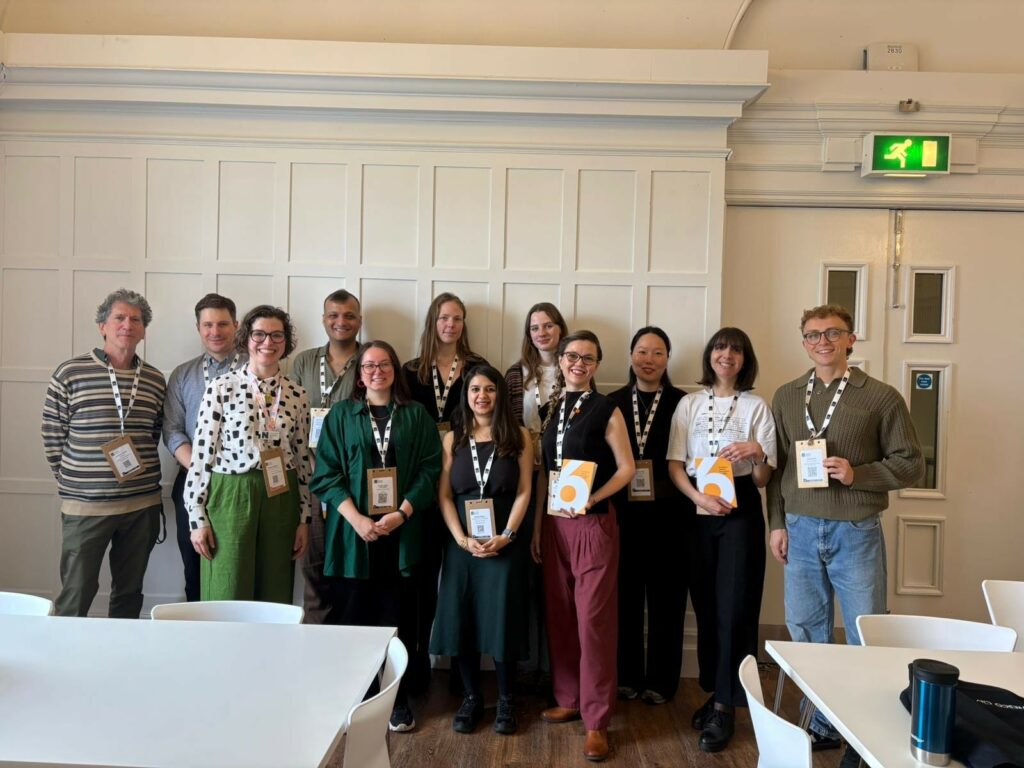
Figure 3: 2025/26 cohort of mentors and mentees at London Book Fair, from left to right, back row: Jonathan Reeder, Sean Gasper Bye, Nachiket Joshi, Kata Veress, Philomena Ieva Marmion, Dasom Yang, Kotryna Garanasvili, Quaid Cey; front row: Rebecca DeWald, Kristin Dilani Nadarajah, Mohini Gupta, Marita Thomsen.
National Centre for Writing translation residencies 2026
In 2026, we are continuing with our translation residencies, both in person and virtual. These run alongside our residencies for writers.
Our in-person residencies are hosted in the Dragon Hall cottage. We usually host two people in the cottage at a time, and the residencies run for between two and four weeks. The main focus is on time to translate, sometimes with a mentor.
We ask all our cottage residents to contribute to the World, Meet Norwich section of our website, where they can reflect on their relationship with Norwich and their experience of the residency. We have different categories, including Walking Norwich, A Postcard to Norwich, A Love Letter to Norwich (popular with translators), Unearthing Norwich, A Taste of Norwich and Voices of Norwich.
Later this summer, we will host a collaborating Dutch children’s writer and a translator. Anke Kranendonk and Laura Vroomen will spend two weeks in the cottage with support from the Dutch Foundation for Literature, collaborating on a translation of a children’s book. They will also facilitate two Family Imagination Day events at Dragon Hall.
All our residents come to the Dragon Hall Social, our monthly networking event, to meet local writers and translators. We don’t usually organise separate readings for our writers or translators in residence, unless their residency is timed to coincide with an English-language publication or if there is some overlap with planned programming.
In November we will host Korean playwright Dong I-Hyang, funded by Arts Council Korea (ARKO), whose play will be available in English. To mark this, we are planning for an informal reading of the play by a local theatre group, The Common Lot.
As in previous years, we are mostly hosting translators working into English, offering in-person residencies in collaboration with various partners, but we also have a number of author/translator residencies where the duo are either collaborating, or just sharing the residency space. We are hoping to launch new translation residencies in 2027, which we look forward to announcing in due course.
Our Visible Communities programme supports UK-based Black, Asian and Ethnically Diverse translators, as well as translators working with heritage or community languages. We offer short in-person residencies in the Dragon Hall cottage, and longer virtual residencies.
The virtual residencies are part-time, over four months now instead of three, to allow for more time to complete the commissions. The virtual residents are paid a fee, which allows them to take the time to work on a translation project, often with a mentor. We have monthly meetings on zoom, during which they share work in progress with each other.
